
Introduction
Smart cities increasingly rely on Artificial Intelligence (AI), Internet of Things (IoT), and big data analytics to enhance urban services and public security. With growing population density and frequent mass events, crowd management has become a critical challenge. Traditional surveillance systems lack intelligence and real-time responsiveness, making AI-driven crowd monitoring systems essential for modern smart cities.
Role of Smart Cities in Crowd Management
Smart cities integrate IoT sensors, AI-powered analytics, and real-time communication networks to build intelligent ecosystems. These technologies enable continuous monitoring of public spaces, early risk identification, and rapid response mechanisms. AI-based crowd management is particularly valuable during large-scale events such as sports matches, religious gatherings, concerts, and transportation hubs.
Smart Surveillance and Real-Time Crowd Monitoring
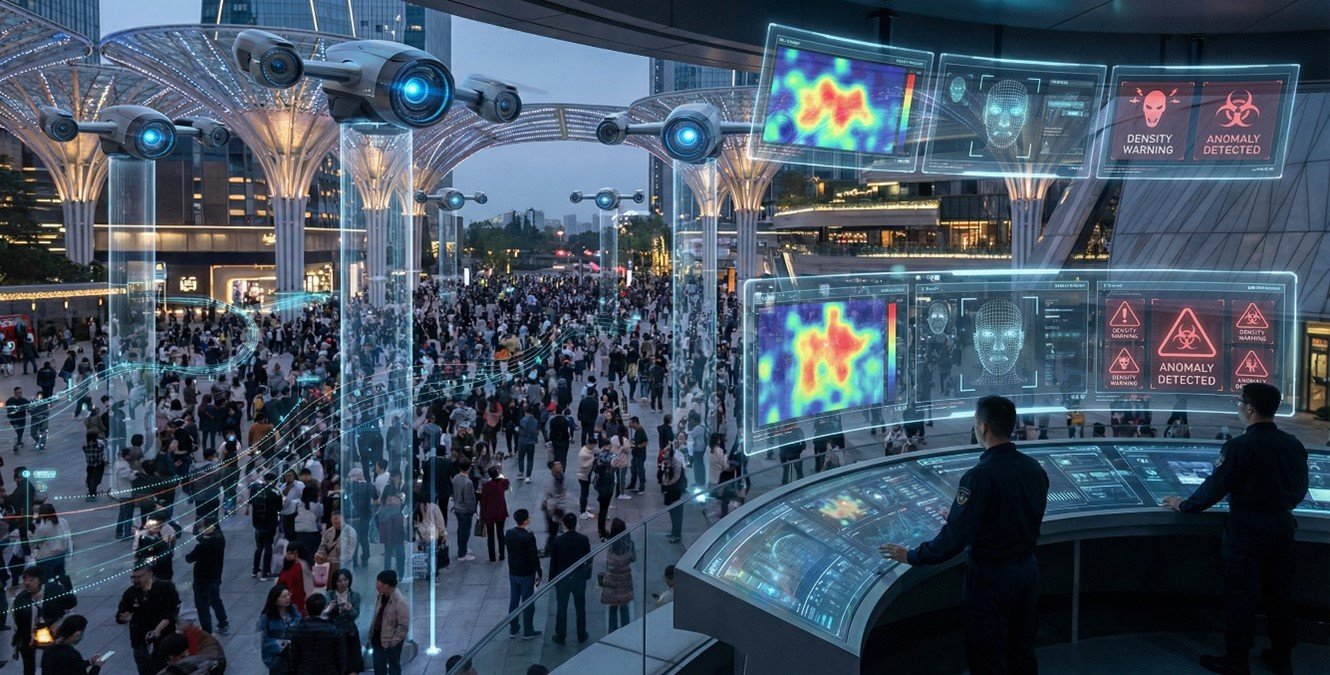
AI-powered smart surveillance systems combine CCTV cameras, IoT sensors, and computer vision algorithms to analyze crowd density, movement patterns, and behavioral changes. Deep learning models—especially Convolutional Neural Networks (CNNs)—process live video streams to detect abnormal behaviors such as pushing, panic situations, overcrowding, and stampedes. These insights allow authorities to intervene before incidents escalate.
Deep Learning Models for Crowd Behavior Detection
Advanced deep learning techniques including CNNs, Conv-LSTM networks, optical flow analysis, and hybrid AI frameworks are widely used for real-time crowd behavior detection. Cloud-based surveillance platforms using pre-trained AI models provide high accuracy with low latency. Research studies report detection accuracy levels of up to 87%, highlighting the effectiveness of AI-driven crowd security systems.
Crowd Counting and Public Safety Assessment
Accurate crowd counting is a key component of risk analysis and emergency preparedness. AI-based crowd counting models use single-column, multi-column, and hybrid neural networks to estimate crowd density in real time. These insights help prevent overcrowding, optimize evacuation planning, and support safer event and urban management strategies.
Emergency Response and Anomaly Detection
AI and IoT-enabled crowd monitoring systems significantly improve emergency response capabilities. Predictive models analyze crowd behavior to anticipate panic and evacuation scenarios. Decision Support Systems (DSS), agent-based simulations, and social force models assist authorities in managing emergencies such as terrorist threats, blocked exits, and sudden stampedes—ensuring faster and safer crowd control.
Privacy Protection and Ethical Considerations
Despite technological advancements, privacy and ethical concerns remain critical in AI-based surveillance. Privacy-preserving techniques such as data anonymization, cryptographic security, and federated learning are increasingly implemented to protect individual identities. Ethical AI deployment requires transparency, fairness, accountability, and strict adherence to legal and regulatory frameworks.
Future Directions
Current AI crowd monitoring systems often rely on limited behavioral indicators and fail to fully capture complex human dynamics. Future research aims to develop human-centric, autonomous systems that integrate environmental context, social behavior, and ethical safeguards. These next-generation frameworks will enhance decision-making accuracy and significantly improve public safety in smart cities.
No comments yet. Be the first to comment!